Research
11 min read
MiCA in Force: Europe's Crypto Rulebook Moves From Drafting to Enforcement
Post-transition MiCA, from licensing wave to staking review.

Published on
July 23, 2026
Introduction
Since our last coverage, MiCA has transitioned from a paper framework to a fully enforced EU law. First discussed as a 150-page proposal in 2023, its stablecoin rules took effect in 2024, reshaping European token holdings. As of mid-2026, the transition has ended, enforcement has begun, and the European Commission has opened a review for the next version of the rulebook.
This piece takes stock of where MiCA now stands: how it got here, what the end of the transition changed, and what it means for institutions and staking.
What is MiCA? A Recap
MiCA, the Markets in Crypto-Assets Regulation, is the European Union's single rulebook for crypto-assets and the firms that service them. It replaced a patchwork of national regimes with one authorization that passports across all 27 EU member states and the wider European Economic Area.
It sets reserve and redemption rules for stablecoins, licensing and conduct requirements for crypto-asset service providers, or CASPs, and disclosure standards for token issuers.
Readers who want the full primer can revisit our earlier explainer and our stablecoin report. The short version is that MiCA turned crypto services in Europe into a licensed activity, on the same principle that governs banks and investment firms.
The MiCA Timeline
MiCA did not arrive as a single event. It phased in over three years, each stage targeting a different part of the market.
- May 2023, adoption. The European Parliament and Council formally adopted Regulation (EU) 2023/1114, establishing the primary legal text and the mandate for ESMA and the European Banking Authority to draft the technical standards.
- June 2024, stablecoin rules apply. The rules for e-money tokens and asset-referenced tokens took effect. Issuers faced reserve, redemption, and governance requirements, and algorithmic stablecoins were prohibited. This is the stage we covered in 2024.
- December 2024, the CASP regime begins. The authorization framework for crypto-asset service providers became applicable, starting an 18-month transitional clock for firms already operating under national registrations.
- Through 2025, national windows close early. Member states were allowed to shorten the transition. The Netherlands, Finland, and others closed at six months, followed by Sweden, then Germany, Ireland, and Austria, producing a staggered rather than uniform rollout.
- June 23, 2026, the final wind-down order. ESMA issued a public statement directing unauthorized providers to stop onboarding EU clients, cease marketing, and wind down operations in an orderly manner.
- July 1, 2026, the transition ends. The grandfathering window expired across all remaining member states. From this date, offering crypto services in the EU without a valid MiCA authorization is a breach of EU law.
The design goal at each stage was the same: move the market from lightly supervised national registration to a single, enforceable licensing standard, starting with the highest-risk instruments (stablecoins) and ending with the service providers themselves.
What happened at the end of the MiCA transition period?
The clearest effect of July 1 was structural. The market did not shrink in value so much as consolidate in number, moving from a large, lightly regulated population to a smaller, fully licensed one.
The firms that lost the ability to operate. Providers that did not secure authorization lost the legal right to serve EU clients. Some large exchanges did not convert in time and restricted or suspended parts of their European operations, and national regulators began issuing operating bans against unlicensed third-country platforms. On the stablecoin side, tokens whose issuers chose not to pursue e-money token authorization, including USDT, the largest stablecoin by global supply, were removed from EU-regulated exchange order books. Notably, USDT's global supply barely moved through the deadline, a sign that delisting changed where the token can be traded in Europe rather than demand for it worldwide.
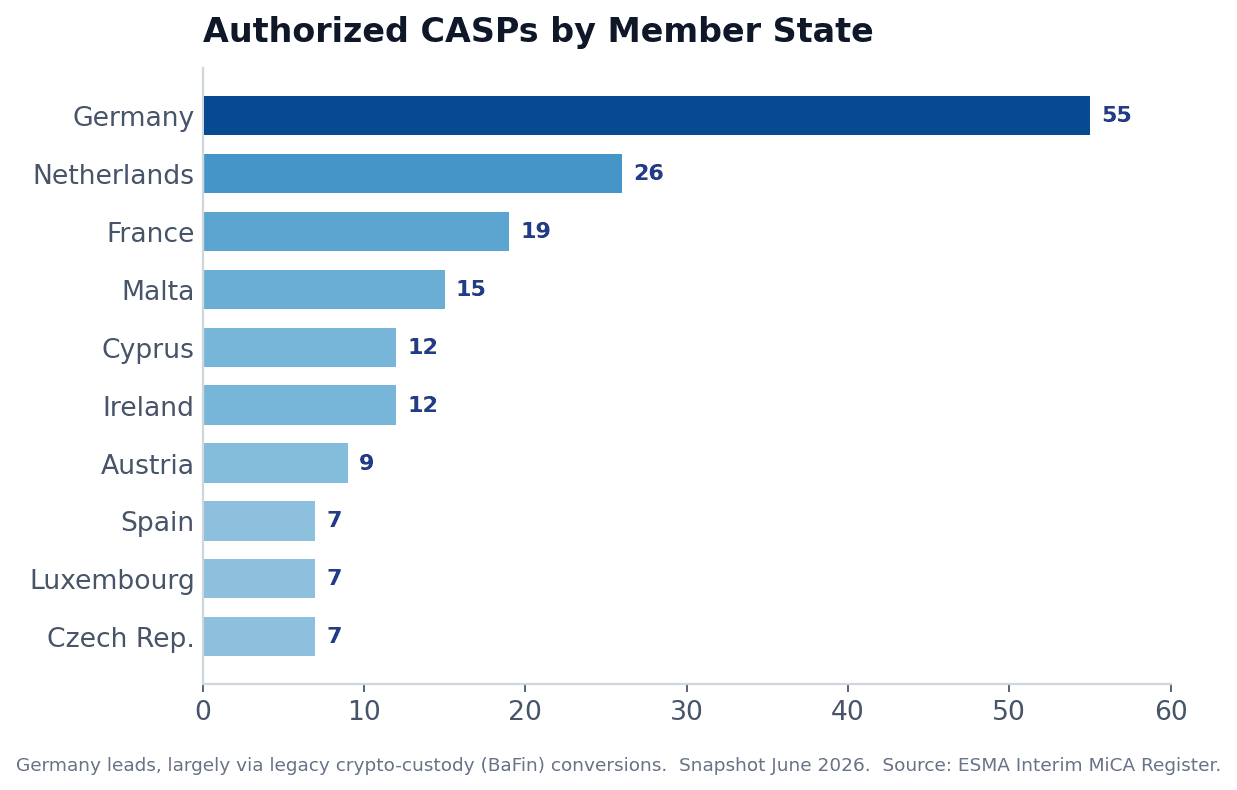
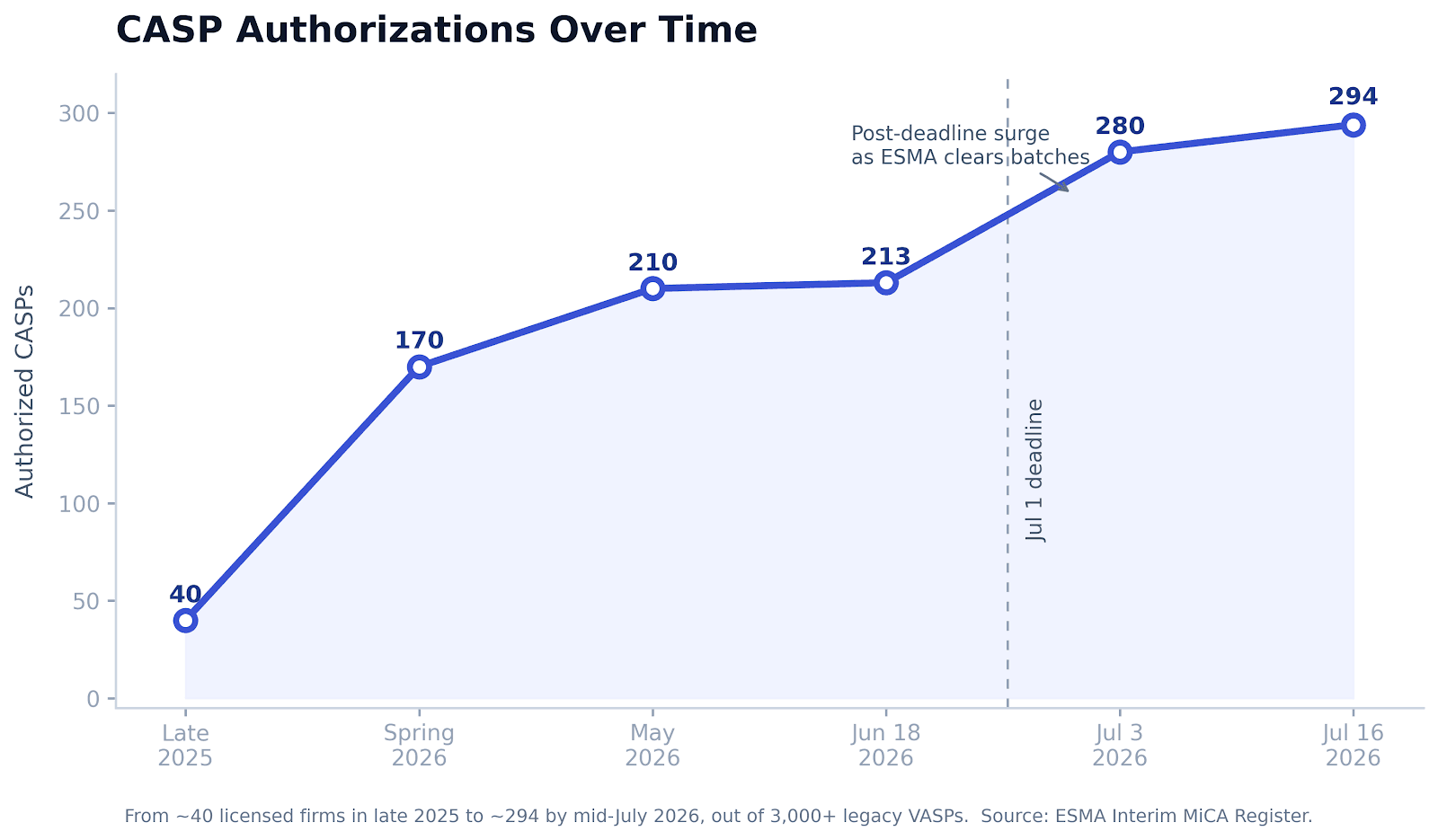
Who registered, and the pattern in the movement. Authorizations climbed steadily and then accelerated into the deadline. The ESMA register grew from around 40 licensed firms in late 2025 to roughly 213 by June 2026 and close to 294 by mid-July, as regulators cleared applications in batches. Licensing concentrated in a handful of hubs, with Germany, the Netherlands, France, Malta, and Ireland accounting for the largest share. The more telling pattern is who came through the door: alongside crypto-native exchanges, the new licensees include established banks and payment firms, a group that had largely stayed on the sidelines through previous cycles.
MiCA: Effects on the Market and Possible Direction
Beyond the closure of non-compliant providers, MiCA produced a handful of visible effects, most of them structural rather than market-driven. Its influence, for one, reaches past Europe: by early 2026, 58% of tokens registered under MiCA originated outside the EU, suggesting the framework is becoming a regulatory benchmark for global issuers. Trading volumes and total value locked largely followed normal market cycles, which is why most of MiCA's ripples were felt in who is allowed to offer services rather than in the services themselves.
One measurable market outcome has been the growth of euro-denominated stablecoins. Supply has increased roughly sixfold since January 2024 to approximately $643 million by mid-2026. Even so, euro stablecoins still represent less than 0.3% of global stablecoin supply, highlighting the continued dominance of dollar-based alternatives.
What are the Long-Term Implications of MiCA?
What all of this means for crypto adoption over the long term is still being argued out, and this is where the more interesting possibilities sit. One view holds that MiCA turns a fragmented market into a single regulated hub, where a common rulebook and passporting make compliance a competitive advantage and the framework becomes a blueprint other jurisdictions copy. The opposing view warns that heavy compliance and capital burdens will push startups, talent, and euro-stablecoin issuers toward lighter-touch regions in Asia, the Middle East, or the United States. Which way it breaks will depend less on the text of MiCA than on how consistently member states enforce it.
This competition is already taking shape:
- The UK FCA's proposed crypto framework reportedly sets stablecoin capital requirements at roughly half MiCA's level, positioning London as an alternative venue for crypto firms.
- The ING-backed Qivalis consortium is expected to launch a euro stablecoin in the second half of 2026, potentially reaching market ahead of the ECB's digital euro.
How does MiCA affect Institutional Adoption and Staking?
If consolidation was the mechanism, institutional participation is the consequence. MiCA's lasting value lies in bridging traditional and on-chain finance: a passportable framework that lets established institutions offer digital-asset services across Europe.
Several major financial institutions have already moved through the framework:
- Société Générale's SG-Forge issues the EURCV stablecoin under MiCA's e-money token regime.
- CaixaBank obtained a full CASP licence from Spain's CNMV.
- Commerzbank secured crypto-custody approval from BaFin.
- Deutsche Bank has applied for its own custody licence.
These developments represent core banking integrations rather than pilot programmes. Custody and settlement infrastructure are prerequisites for institutional allocation, and MiCA provides a clearer path for both.
Staking Moves Into Focus
Staking remains one of the largest unresolved areas of the framework.
The MiCA 2.0 review, launched on 20 May 2026, formally defines staking as the immobilisation of crypto-assets to support proof-of-stake networks in exchange for rewards and asks whether dedicated prudential and conduct requirements should apply. A report is due to the European Parliament and Council by 30 June 2027.
The likely direction is consistent with MiCA's broader approach:
- Staking services operate through licensed entities.
- Client assets remain segregated.
- Authorized CASPs cannot route assets to unlicensed providers.
For institutional allocators, custodians, and ETF issuers, the result is a more predictable path to on-chain yield. Instead of navigating 27 separate national approaches, firms can operate within a common supervisory framework.
Current State of the Market
The authorization process remains ongoing, with several notable approvals announced in July 2026.
- BitPay received a CASP licence from the Dutch AFM on 16 July 2026.
- Coinbase continues to passport services across the EU through its Irish authorization.
- Kraken operates through licences in both Ireland and Luxembourg.
The trend is increasingly clear: exchanges, payment providers, and banks are consolidating European operations under a single passportable licence.
Attention is also shifting toward supervision. Under the proposed Market Integration and Supervision Package (MISP), ESMA could assume direct oversight of significant CASPs as early as 2027. The European Commission supports broader ESMA supervision, while the European Parliament favours a tiered model that would leave smaller firms under national regulators.
Conclusion
MiCA's first phase was disruptive by design. A fragmented, lightly regulated market consolidated around licensed participants, raising compliance standards across the sector.
However, that disruption served a broader objective: creating the regulatory foundation for institutional participation. Banks are entering the market, payment firms are passporting services across Europe, and reviews covering staking and DeFi are already underway.
The framework remains a work in progress, but the direction is clear. Institutional engagement is increasing, regulatory clarity is expanding, and MiCA is emerging as one of the defining frameworks for digital-asset adoption.
Frequently Asked Questions
How many firms are licensed under MiCA?
The ESMA register grew from around 40 licensed firms in late 2025 to roughly 213 by June 2026 and close to 294 by mid-July. Licensing concentrated in Germany, the Netherlands, France, Malta, and Ireland.
Who supervises MiCA-licensed firms?
National regulators authorize firms today, but oversight may centralise. Under the proposed Market Integration and Supervision Package, ESMA could assume direct oversight of significant CASPs as early as 2027, with the Parliament favouring a tiered model that keeps smaller firms under national supervision.
Does MiCA regulate staking?
Not yet directly. The MiCA 2.0 review, launched 20 May 2026, defines staking as immobilising crypto-assets to support proof-of-stake networks and asks whether dedicated requirements should apply, with a report due by 30 June 2027.
Can one MiCA licence cover all of Europe?
Yes. A single authorization passports across all 27 EU member states and the wider European Economic Area.
Are traditional banks using MiCA licences?
Yes. Société Générale issues EURCV under the e-money token regime, CaixaBank holds a full CASP licence from CNMV, Commerzbank has BaFin custody approval, and Deutsche Bank has applied for its own.
About Luganodes
Luganodes is a world-class, non-custodial blockchain infrastructure provider that has rapidly gained recognition in the industry for offering institutional-grade services. It was born out of the Lugano Plan B Program, an initiative driven by Tether and the City of Lugano. Luganodes maintains an exceptional 99.9% uptime with round-the-clock monitoring by SRE experts. With support for 40+ PoS networks and serving 60+ institutional cliens, it ranks among the top validators on Polygon, Polkadot, Sui, and Tron. Luganodes prioritizes security and compliance, holding the distinction of being one of the first staking providers to adhere to all SOC 2 Type II, GDPR, and ISO 27001 standards as well as offering Chainproof insurance to institutional clients.
The information herein is for general informational purposes only and does not constitute legal, business, tax, professional, financial, or investment advice. No warranties are made regarding its accuracy, correctness, completeness, or reliability. Luganodes and its affiliates disclaim all liability for any losses or damages arising from reliance on this information. Luganodes is not obligated to update or amend any content. Use at your own risk. For specific guidance, please consult a qualified professional.