Research
12 min read
How Duration and Liquidity Shape Institutional Staking Yield
Yield follows the rhythm of lockups, queues, and liquidity.

Published on
August 24, 2026
Introduction
For institutions entering crypto through exchange-traded funds (ETFs) and corporate treasury allocations, it is natural to picture staking yield as something like a stock dividend or a bond coupon: a simple percentage paid for holding an asset. Staking yield is a little different, though. It follows its own set of rules, and those rules are worth understanding before comparing it to traditional income products.
A traditional ETF distribution is set by commercial terms. A Proof-of-Stake (PoS) yield works differently. It moves with several factors at once: the protocol's issuance rules, how much the network is being used, how much of the token supply is staked, and something we can call duration friction.
Duration friction is simply the time capital spends locked up as it enters and leaves the staked state. It never shows up in a token's spot price. On an exchange, an asset can trade with instant liquidity, even while that same balance sits in a multi-week exit queue on-chain. As staked assets move onto institutional balance sheets and into daily-liquidity ETF wrappers, understanding this duration has become just as important as reading the headline Annual Percentage Yield (APY).
1. Network Mechanics: Why Staking Queues Exist
To read staking yields accurately, it helps to start with a simple question: why can't capital move in and out of a network instantly?
In traditional markets, central clearinghouses and commercial banks handle redemption liquidity quietly in the background. A decentralized blockchain has no such intermediary. Its security rests on the integrity of consensus. So if a single large entity could stake or unstake tens of billions of dollars in one block, it could unsettle the validator set, open the door to governance attacks, or pull away network security in a moment of market panic. This is exactly the risk that entry and exit queues are built to manage.
Entry and exit queues act like a network's built-in traffic controllers. They apply protocol rate limits so that validators join and leave at a safe, predictable pace.
Moving into and out of the network happens in three stages:
- Activation: The wait while committed capital is processed by the protocol and starts earning rewards.
- Unbonding: A set cooldown period after you request an exit. During this time capital stops earning yield but stays locked, and it can still face slashing penalties if the validator misbehaves.
- Settlement: The final sweep that returns unbonded funds to a liquid, spendable balance.
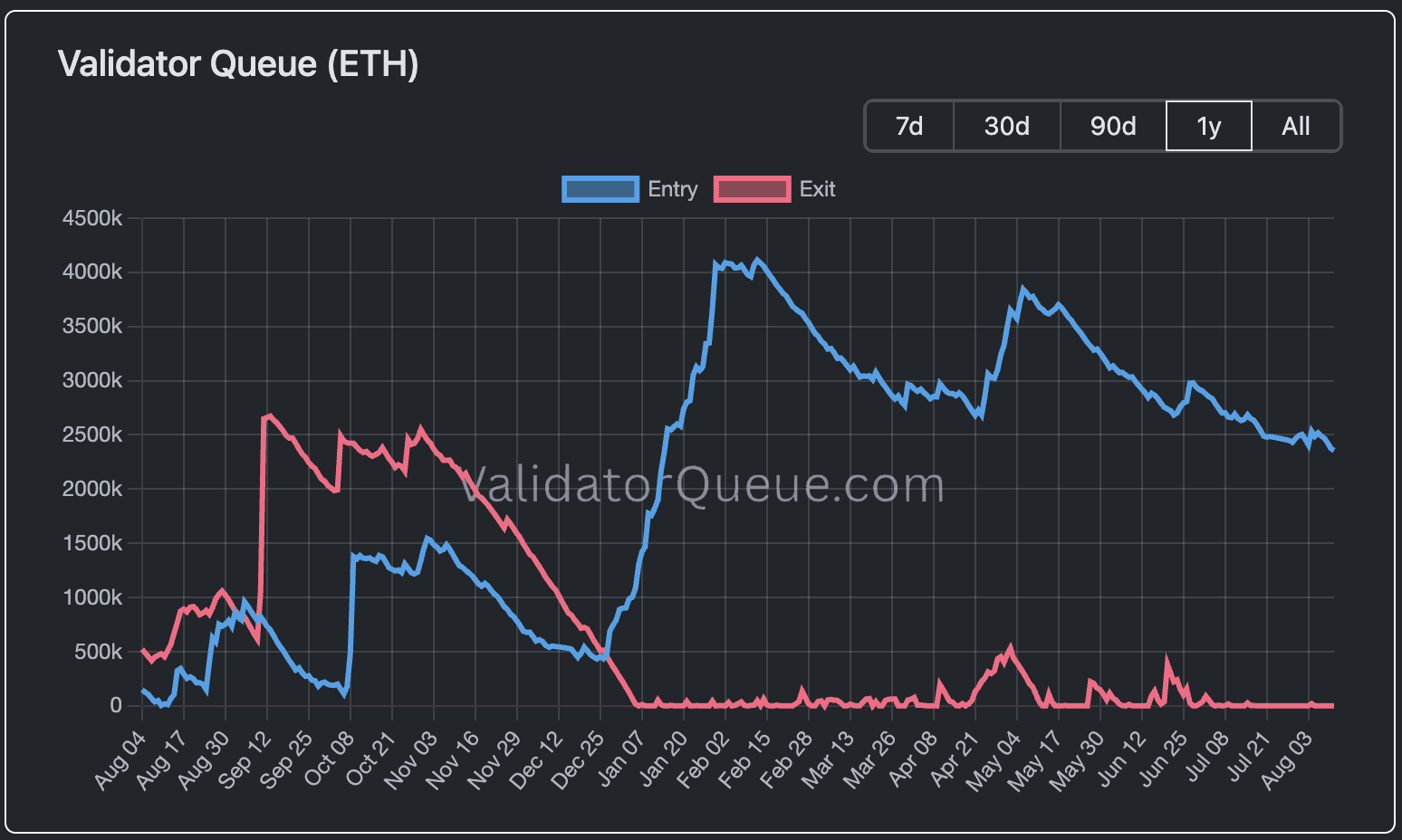
Because these queues run under fixed throughput limits, staking duration is not a fixed number. It expands and contracts with real-time market conditions.
Entry queues tend to fill up when the market is optimistic and capital rushes in to secure yield. Exit queues do the opposite, lengthening during market stress or periods of structural rebalancing. On Ethereum, heavy institutional onboarding can push entry wait times noticeably higher, while large operator withdrawals can create temporary spikes in the exit queue. When on-chain queues stretch out, secondary markets step in to absorb the wait. Liquid Staking Tokens (LSTs such as stETH) trade at a small discount to spot, which reflects the time value of money spent waiting in line.
2. The Inverted Yield Curve: How Staking Differs From Bonds
In traditional fixed-income markets, investors expect a liquidity premium, an idea developed by economists John Maynard Keynes and John Hicks. The premium works like this: if you lock up your money for ten years instead of ten days, the borrower has to pay you a higher interest rate to make up for the flexibility you give up and the illiquidity you take on. This is why traditional bond yield curves usually slope upward as the timeframe gets longer.
Across Proof-of-Stake networks, this relationship works quite differently.
Staking yields are set by protocol algorithms and by how much of the network is participating, not by how long any one investor promises to stay locked up. When participation is low, the protocol raises reward rates to attract more stakers, whether the exit queue happens to take two days or two months.
To a traditional fixed-income allocator, the result can feel surprising: higher yields often sit behind shorter lockups, not longer ones. A network with high participation and firm rate limits, like Ethereum, may pair a lower gross staking yield with a multi-week queue.
Networks with different issuance schedules or higher yield parameters, such as Solana or Near Protocol, can offer higher APYs alongside much shorter unbonding windows.
In PoS, payout rates reflect a protocol's inflation model and its participation rate, rather than a reward for accepting a longer lockup.
One more factor explains most of the gap between a chain paying 3% and one paying 12%: participation. On most Proof-of-Stake networks, the reward pool is set by issuance and fees and then shared across everyone who stakes, so dividing the same pool among more stakers leaves a thinner slice for each. A lower headline yield usually signals high participation and restrained issuance, the marks of an efficient, well-secured network, while a higher yield reflects a different design choice rather than a better deal. Hence, the key question is what drives each yield, rather than a simplified comparison of numbers.
3. How Different Networks Handle Lockups
Every blockchain makes deliberate design choices, balancing consensus security against capital flexibility. The result is a wide spectrum:
- Cardano: Applies no unbonding lockup, so delegated stake stays liquid at all times.
- Solana: Settles stake changes at epoch boundaries, which takes roughly two days.
- Cosmos Hub: Uses a firm 21-day unbonding period, chosen to prioritize network stability.
- Ethereum: Uses protocol rate limits (under EIP-7514 and EIP-7251) to cap how much stake enters and exits each day, followed by an automated settlement sweep.
- Avalanche: Works much like a traditional term deposit. Stakers choose a term between two weeks and one year, and principal is returned at maturity with no exit queue.
- Near Protocol: Mandates an unbonding window of 4 epochs (roughly 36 to 48 hours) before funds can be withdrawn.
- Polygon PoS: Requires waiting 80 Ethereum mainnet checkpoints (approximately two to four days) to unbond staked tokens.
- Sui: Settles unstaking requests at 24-hour epoch boundaries, releasing funds at the start of the next epoch.
4. Staking Inside an ETF Wrapper
When staking sits inside an exchange-traded fund, the fund's day-to-day operations have to work alongside on-chain lockup rules.
An ETF that offers daily redemptions promises investors they can exit their position on any trading day. If the manager staked 100% of the underlying tokens, though, a sudden wave of redemptions would be hard to meet, since the fund cannot pause and wait out an on-chain exit queue to hand back cash.
To handle this, fund treasurers keep an unstaked liquidity buffer of cash or liquid tokens on hand. That buffer does come with a tradeoff, since assets that are not staked do not earn the staking yield:
Net Staking Yield = Gross Network Rate × % of Fund Staked
Take an Ethereum ETF that keeps 10% to 30% of its holdings unstaked to meet daily redemptions. A gross network rate of about 2.66% would come down to a net contribution closer to 1.86% to 2.39%, before management fees are taken into account.
Queues also touch pricing stability. In traditional equity ETFs, specialized intermediaries called Authorized Participants keep the fund's trading price in line with the value of its underlying assets, buying or redeeming shares in real time. When on-chain queues lengthen, market makers cannot redeem staked tokens right away. They carry inventory risk while they wait in the exit queue, so during volatile periods they tend to widen their bid-ask spreads.
Staking and traditional finance differ in their mechanics, yet the financial industry has been quick to adopt these networks, drawn by their distinctive yield and their growing utility as productive assets. For many institutions, this is an early step toward what could become a core layer of the world's financial rails.
Many of the operational requirements covered here, from liquidity buffers to exit queues, map closely onto ideas traditional finance already knows well, such as redemption reserves and settlement windows. As both sides work to close that gap, corporate treasuries now hold multi-billion-dollar staked positions directly in their balance-sheet reserves.
5. Institutional Strategy: Building a Staking Ladder
Comparing raw APYs across networks without factoring in duration can be misleading. A high headline yield offers little comfort if capital is locked up during a major liquidity event, while a more modest yield that exits quickly serves a very different treasury need.
Rather than ranking chains by raw yield alone, allocators are often better served by treating a multi-chain portfolio like a bond ladder. Each network then plays a distinct role, based on its duration profile:
- Short-Duration Layer (Solana, Cardano): The tactical liquidity sleeve. Well suited to capital that needs flexibility for near-term rebalancing or day-to-day liquidity.
- Defined-Term Layer (Avalanche): A way to match cash flows to liabilities with fixed dates, which makes horizon planning precise over multi-week or multi-month windows.
- Long-Duration Anchor (Ethereum): Core structural capital meant to be held for the long term, where deep consensus security and economic depth matter more than quick exit speed.
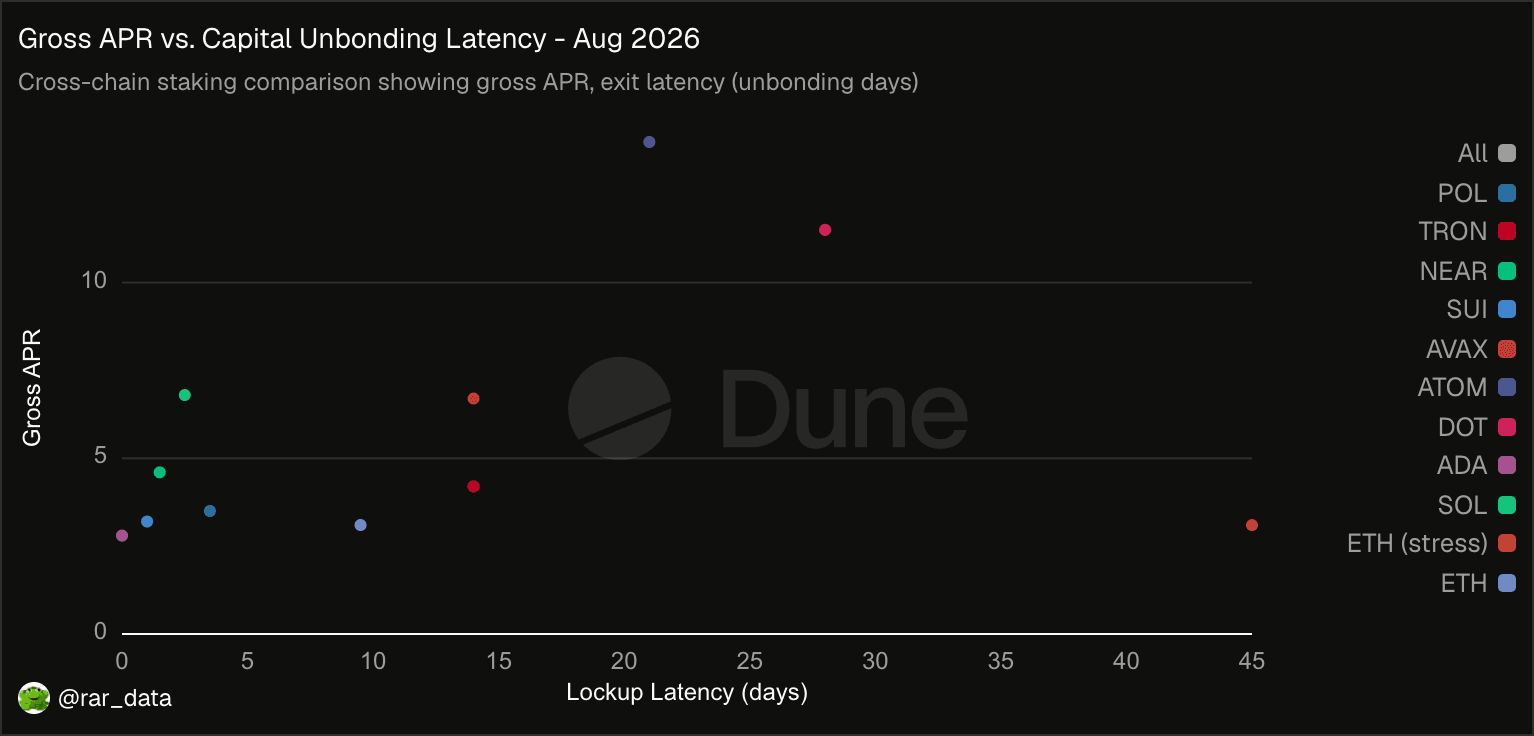
As staking grows into core institutional infrastructure, the edge shifts away from chasing the highest advertised rate and toward active duration management: matching on-chain lockup behavior to institutional liabilities, and sizing liquidity buffers to live queue conditions.
Frequently Asked Questions
Is staking yield the same as a stock dividend or a bond coupon?
No. A dividend or bond coupon is set by commercial terms, while a Proof-of-Stake yield is produced by the protocol itself: its issuance rules, how much the network is used, and how much of the supply is staked. It also carries duration friction, the time capital spends locked while entering and leaving the staked state.
What is the term structure of staking?
It is the relationship between a staked asset's yield and the total time it takes to enter, unbond, and settle capital from the network. That total time shifts with protocol design and with real-time congestion.
Why do Proof-of-Stake networks have unbonding periods?
Unbonding periods exist to protect network security. They apply protocol rate limits so validators cannot join or leave too quickly, which keeps the validator set stable and guards against governance attacks or sudden security drops during market stress. The tradeoff is that exiting capital waits before it becomes liquid again.
How long does it take to unstake on different blockchains?
It depends on the protocol. Cardano applies no unbonding lockup, Solana and Near Protocol take roughly two days, and Cosmos Hub enforces a 21-day period. Ethereum uses daily rate limits followed by a settlement sweep, while Avalanche instead uses a fixed term of two weeks to one year.
Why do different blockchains offer different staking yields?
Yields differ mainly because of issuance schedules and participation. On most Proof-of-Stake networks, the reward pool comes from issuance and fees and is shared across everyone who stakes, so a higher staking ratio spreads the same rewards thinner. A lower yield often reflects high participation and restrained issuance.
Why can a higher staking yield come with greater liquidity?
Because Proof-of-Stake yields come from protocol issuance algorithms and network participation rates, not from how long capital is locked. A network with higher reward parameters can pay elevated APYs no matter how quickly capital can exit.
What is a liquid staking token (LST)?
A liquid staking token, such as stETH, represents staked capital in a tradable form. When on-chain exit queues lengthen, LSTs let holders reach liquidity on secondary markets. They usually trade at a small discount to spot, which reflects the time value of money spent waiting to exit.
Do staking ETFs pay the full headline network yield?
Usually not. To meet daily redemptions, ETF managers keep part of the fund unstaked, often 10% to 30%. For an Ethereum ETF, that can bring a roughly 2.66% gross rate down to a net contribution near 1.86% to 2.39%, before management fees.
About Luganodes
Luganodes is a world-class, non-custodial blockchain infrastructure provider that has rapidly gained recognition in the industry for offering institutional-grade services. It was born out of the Lugano Plan B Program, an initiative driven by Tether and the City of Lugano. Luganodes maintains an exceptional 99.9% uptime with round-the-clock monitoring by SRE experts. With support for 40+ PoS networks and serving 60+ institutional cliens, it ranks among the top validators on Polygon, Polkadot, Sui, and Tron. Luganodes prioritizes security and compliance, holding the distinction of being one of the first staking providers to adhere to all SOC 2 Type II, GDPR, and ISO 27001 standards as well as offering Chainproof insurance to institutional clients.
The information herein is for general informational purposes only and does not constitute legal, business, tax, professional, financial, or investment advice. No warranties are made regarding its accuracy, correctness, completeness, or reliability. Luganodes and its affiliates disclaim all liability for any losses or damages arising from reliance on this information. Luganodes is not obligated to update or amend any content. Use at your own risk. For specific guidance, please consult a qualified professional.